
Far from being just an exhibition centre, the Exploratorium is heavily engaged in outreach, connection and community activities. As stated on their “Our Story” page, a lot of collaboration takes place in order to bring a greater public understanding of science, but also public awareness of issues that are usually accused of being hidden behind closed doors, or so saturated in the media and political dogma that the public become disengaged from them.
If you are in the bay area, and/or can get to the Exploratorium without too much hassle, you should definitely keep an eye on their calendar of events. And even if you can’t, from time to time some events may involve a webcast or some other way to remotely access it during it or afterwards.
And so to give you both an insight into one such event which engages the community, and the ‘behind the scenes’ in hosting it.
Last evening’s event, titled “Conversations About Resilience: Adaptive Governance” was held in the Exploratorium’s Observatory, which quickly became my favourite part of the whole building.
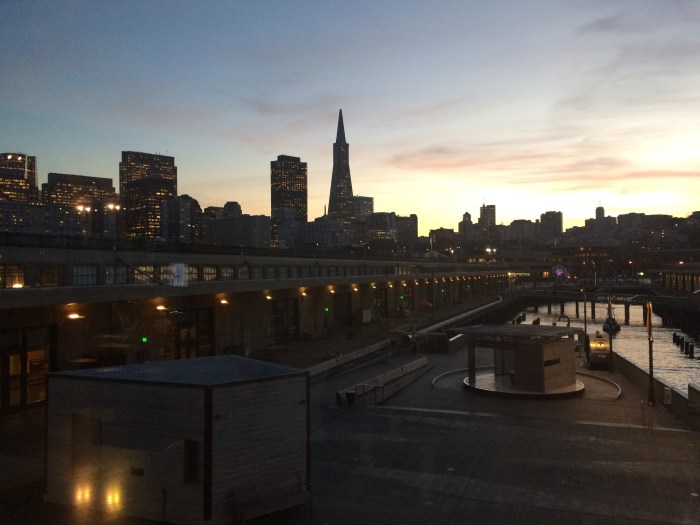
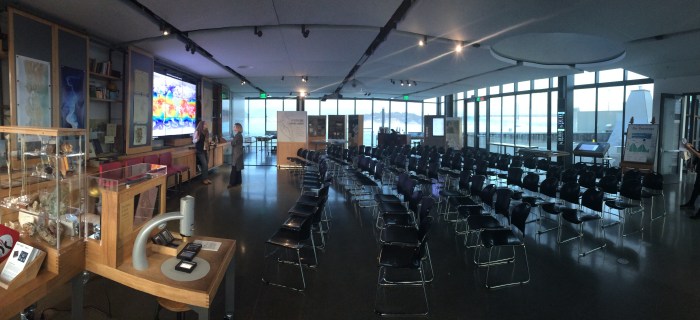
I was one of two volunteers helping for the night. It was clear that extra hands-on-deck made light work of the physical set up. This further freed staff to attend to logistics and when they arrived, our speakers. Volunteers are very appreciated at the Exploratorium!

It was nice to have a pre-event sit down and chin-wag between all those making the evening happen. We were even treated to a sandwich and drink each from WholeFoods. 🙂 The chat wasn’t solely about the event itself, in fact, a lot of it was general chit-chat and catching up between acquaintances. I think I remember rightly that there was a mention of someone going karaoke on Mondays and we should all come along! This to me put the humanity and soul into the process. If you’re invested in to your collaborators as people not just entities from another agency etc, then certainly there is more productive chemistry.
When the attendees began to arrive, they too engaged in discussion. I observed that, as per the norm, it was fairly clique-y, and those who came on their own tended to the food table and parked themselves onto a seat. However the rotating graphics and visualisations on the big screen seemed to encourage discussion.


The demographic was mostly middle aged/older, some representation of younger people. Speaking to the attendees many had already heard about the topic, and were colleagues or friends of those giving a talk. One gentleman I spoke to was recommended to do so by his wife, as he is working on a resilience project in a city in eastern India. He was hoping to get some ideas from these talks.
The talks are part of an initiative called “Resilient By Design: Bay Area Challenge“, which is, to quote their website:
A year-long collaborative design challenge bringing together local residents, public officials and local, national and international experts to develop 10 innovative community-based solutions that will strengthen our region’s resilience to sea level rise, severe storms, flooding and earthquakes.
The evening’s talks focused mostly on sea-level rise and adaptive governance.
Adaptive governance
After introductions, first up was Mark Lubell from UC Davis. A focused but charismatic guy, who was certainly interested in the karaoke idea floated earlier… 😉


His talk centered around his studies on adaptive governance, applied to the issue of sea-level rise in the Bay Area. There were interesting visualisations on his slides, including a projected impact map of the whole bay area: what would happen to the whole transport network if only Berkeley flooded. This example emphasised the need for interdependence between organisations and agencies, as their vulnerabilities are also interdependent.
He visually demonstrated that adaptive governance, which is more of a bottom-up approach to tackling issues is very complex, where many stakeholders and decision makers are involved in the many decisions to made. The challenges were ranging, he said, particularly civic engagement (where the public’s and public official’s focuses tend to be on more immediate problems e.g. homelessness, rather than longer-term issues), and political leadership (which is still mostly at local level regarding sea level rise). Ideas for solutions came from engaging with stakeholders, one such was better engagement with climate science should not involve just more portals (where you can get data, graphs etc), but rather a more person-to-person ‘translation’, like a “service center” for interaction regarding climate science.
You can read more about Mark’s work here. It is summarised in a nice concise way, and the full PDF is available if you wish to look at that too.
Power to the people

Paul Kumar, Political Director from Save The Bay gave a really interesting talk resoration efforts in the Bay. But what intrigued me most was when he talked about ‘Measure AA’. I was fascinated about the political process, which is somewhat unique and certainly different to they way things work back in the UK.
‘Measure AA’ was a proposition (one of many, it seems) offered to the residents of the Bay Area. The democratic process is placed entirely on them, where the proposition goes to a ballot. The public can choose to reject or approve it. ‘Measure AA’ proposed:
To protect San Francisco Bay for future generations by reducing trash, pollution and harmful toxins, improving water quality, restoring habitat for fish, birds and wildlife, protecting communities from floods, and increasing shoreline public access, shall the San Francisco Bay Restoration Authority authorize a parcel tax of $12 per year, raising approximately $25 million annually for twenty years with independent citizen oversight, audits, and all funds staying local?
Basically, everyone, do you want your taxes to go up by $12/year to pay to protect the Bay?
Incredibly, but perhaps not so surprising in these parts, 1.3 million people (70%) voted ‘yes’ to Measure AA, passing with over 70% approval.
Paul stated that critical to this success was engaging with not just the public, but a broad number of institutions who supported Measure AA and therefore could also get out a message of why it was important, e.g. Bay Area Council, Silicon Valley Leadership Group, Ducks Unlimited, Coastal Conservancy, Santa Clara Valley Water District, Trust for Public Land and the Sonoma Land Trust. And that is just naming a few.
Some personal light research has revealed that despite Measure AA being passed, there are still challenges, particularly with funding for Bay restoration projects.
A major player: progressive

The San Francisco Bay Conservation and Development Commission (BCDC) to me is a major player in what can happen in and around the Bay. Brad McCrea is the Regulatory Director for the BCDC, he talked about what the BCDC is and what it does, and what it plans going forward.
Brad also echoed Mark’s earlier points regarding interdependence, stating that the Bay is one entity, changes in one part affect another; the coasts, wetlands, the floor…
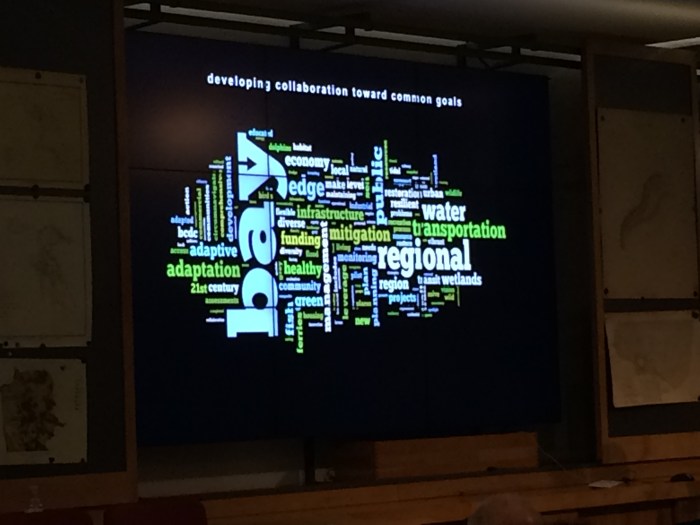
Ironically, the BCDC was originally set up to minimise the amount of fill being used to reclaim land. Reclaiming land from the Bay was a major part of San Francisco’s development history. Now there is filling for habitat restoration, e.g. building wetlands etc, which will take “a lot of dirt”! A key message from Brad was that…:
“…Fill should benefit the entire region, [not just the few]”
So the BCDC have to be progressive, and I think it sounds they are doing a good job given the amount of bureaucracy that they have to navigate.
Living shorelines: actually not just black (grey) & white (green)
Last but not least, Marilyn Latta of the California State Coastal Conservancy gave us her insights into the Bay’s shorelines. There were a couple of graphics in particular that, as a Geography teacher, I would find very useful in the classroom for example this one regarding ‘shoreline hardening’:

The second graphic was showing a potential solution to this: a living shoreline. However it’s not as black-and-white as I and many other Geography teachers have taught in the past. In fact, engineering a shoreline neither has to black (grey) or white (green), but can be somewhere in between too. Living shorelines by nature tend to be more towards the green end of the spectrum, but can contain elements of grey.

And Marilyn proposed: what about living sea walls or docks? “One size doesn’t fit all.”
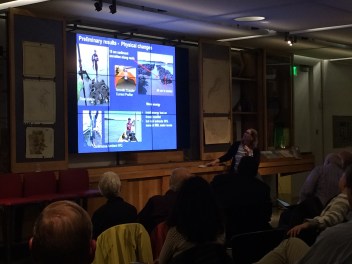 Marilyn then presented a case study of a living shoreline project in San Rafael using oyster shells.
The bay bay bottom is vibrant, with shellfish beds, macroalgal beds, rock, mud etc. Interestingly but not surprisingly perhaps, the bay bottom is not all publicly owned and not all private owners know they own a parcel!
And now a link for teachers, particularly those who are interested in the Bay habitat. Marilyn made us aware of an interactive resource called the Subtidal habitat Bay area interactive that is worth exploring. Go check it out.
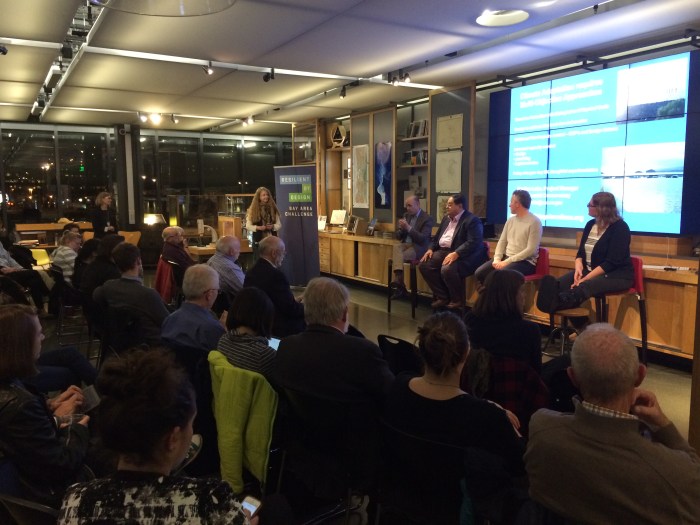
A Q&A session with the speakers then took place. There were some good questions and responses but I couldn’t capture them all. Here’s what I caught:
 Mark was asked about which agency gives him the most hope: he felt that BCDC is doing a lot and that they could be the base for adaptation to sea level rise, there are some constraints and need more evolving to become such.
- A query rose regarding public participation. Marilyn stated that public meetings for the Living Shorelines were held even though they weren’t required, in order to make sure concerns were heard and decisions can be explained. Brad highlighted that the BCDC held several workshops for public participation.
- One of the most probing questions was “Is adaptive governance going to change quick enough for the changes brought about climate change?” Mark refereed back to his ‘messy’ stakeholder diagram, which shows a lot of agencies and cooperation, and that helps to accelerate governance with a strong democratic system.
- In responding to a question regarding whether there had been much opposition to this collaborative work, Marilyn gave a somewhat humourous antidote that when the San Rafael project hit the front page on The SF Chronicle, she received a skeptical email with a seemingly sarcastic query: “Are the oysters going to drink up the water!?”. Mark recommended a book – “The Water Will Come”, which highlights differing regional standpoints (e.g. climate change denying is really low in the Bay area unlike Miami, which is equally if not more at risk.)
- Inevitably it seems now a days, there was a question about whether changes at the Federal government would hinder the work that needed to be done. Brad in particular felt that there is already a lot of resilience where people have been in place for years and have existing networks at a regional level that can continue to work, regardless of what the Federal government will do or not do. But of course, funding from that level is always a consideration.
The night appeared to be very well received by all those present and the Exploratorium team believed it to be a success, or a ‘good one!’ as a colleague emoted. I learned so much myself, especially from an ‘outsider looking in’ standpoint. Although I may not be personally invested in the work in the bay, I’m certainly remotely attached to it given that the issue of climate change and sea-level rise is a global threat.
A final thought; one thing I was surprised to hear was that the observatory section of the Exploratorium, which was an excellent physical space for this event, does not get as big a footfall as they would like during open hours. This part of the museum admittedly has a gentler pace, but that’s part of it’s charm. I’ll post a more dedicated feature about the Exploratorium’s observatory soon, so stay tuned!
NB: I did my best to balance taking contemporaneous notes, take pictures and attend to guests. So if you spot anything which is a tad inaccurate, or I misheard a quote, or attributed a quote etc to the wrong person, do give me a shout! Of course you are also welcome to offer your insights in the comments section.
Enjoyed this entry? Please sign up to email alerts by clicking on the ‘Follow’ bottom in the bottom right, giving you a shout when I post again in the near future! 🙂

 Geogramblings
5 thoughts on “Resilience”