
I am thrilled to announce that a chapter I have written, “At and Beyond the Chalkface: The Role of the Geography Teacher in the Age of Climate Crisis,” is now published in the brand new book, ‘What is Geography Teaching, Now?’ which was officially released on the 19th September!
This essential volume brings together a wealth of voices from across the geography education community, and I am honoured to contribute to this timely conversation. You can find the book here (ISBN: 9781036005986).
My chapter argues that geography teachers are uniquely positioned—and have a profound responsibility—to guide young people through the complexities of the climate crisis. This role extends far beyond delivering the curriculum; it’s about being storytellers, knowledge keepers, and inspiring enablers for a generation facing an uncertain future.
Here’s a summary of the key themes I explore.
1. The Climate Crisis is a Mental Health Crisis
We can no longer ignore the psychological toll of the climate crisis. Citing the IPCC and global studies, the chapter highlights the prevalence of eco-anxiety among young people—feelings of helplessness, anger, and persistent worry about the future. As educators, we have a dual duty: to teach the dire facts without fuelling despair.
2. The Power of Our Language
The language used in media, science, and our classrooms has converged, often instilling guilt and inadequacy. I reflect on my own past use of language and propose a simple but powerful shift: moving from commanding words like “should” to empowering questions with “could” and “would.”
- Instead of: “We should cycle to school.”
- Try: “Would you cycle to school?” or “How capable are you of reducing energy waste at home?”
This small change avoids assumptions about student responsibility and capability, and instead opens the door to powerful, solution-focused discussions.
3. Building Climate Literacy Systematically
Reducing anxiety involves tackling feelings of uncertainty and uncontrollability. A key weapon in our arsenal is improving climate literacy. My chapter presents a framework for a systematic approach to this in the classroom, linking the NOAA’s Essential Principles of Climate Literacy directly to classroom principles, key messages, and practical teaching activities.
I am excited to promote the interactive version of this framework, which you can explore here: https://bit.ly/Geog-ClimateLit
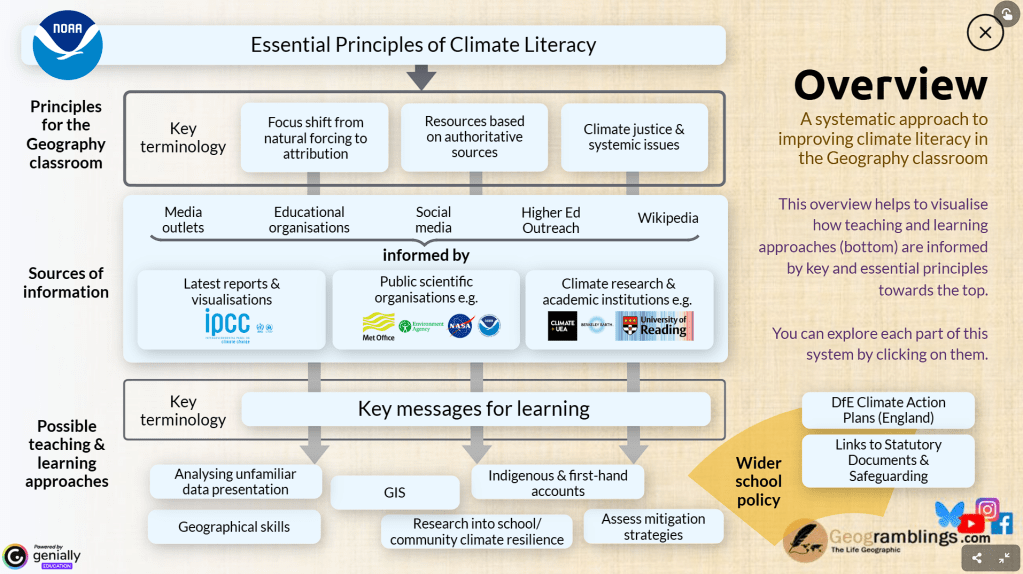
This interactive tool allows you to delve deeper into the rationale, resources, and ideas for applying this structure in your own teaching.
4. A Decolonial Approach is Essential
Achieving a climate-resilient society is not just a moral or historical issue; it’s a scientific one. The IPCC states that rapid, effective mitigation must be equitable and just. The chapter provides practical ways to decolonise climate change education, including:
- Rethinking “Sustainability”: Challenging colonial models like “fortress conservation” and highlighting the efficacy of Indigenous stewardship.
- Valuing Lived Experience: Using resources like the Young People at a Crossroads (YPAX) project, which centres the intergenerational and intercultural knowledge of young people from the Global South.
- Using Story-Telling: Employing imaginative techniques like hot-seating and tools like Climate Dice to help students construct narratives and explore solutions.
5. The Climate Crisis is a Safeguarding Issue
This is a crucial argument for all school staff. I outline three components that frame the climate crisis as a core safeguarding issue:
- The documented impact on mental health (eco-anxiety).
- The increasing physical impacts felt in the UK, which disproportionately affect the most vulnerable.
- Statutory safeguarding duties that require us to protect children from harm.
Geography-literate staff can lead the charge by using geographical tools to assess local climate risks and by mapping safeguarding links across the curriculum, directly supporting the development of mandatory School Climate Action Plans.
A Call to Reflection and Action
My chapter concludes with reflective questions to help educators move forward. I leave you with a few of them here to ponder:
- How can you evaluate the climate literacy of yourself, your students, and your school community?
- To what extent does your curriculum promote climate literacy, and how could the systematic framework improve it?
- How can you use your school’s youth voice and cultural backgrounds to decolonise your teaching of climate change?
Teaching geography now is more vital than ever. It is not about having all the answers, but about empowering our students with the knowledge, critical thinking skills, and, most importantly, the hope they need to find their way home to a sustainable future.
Explore the interactive classroom framework: https://bit.ly/Geog-ClimateLit

 Geogramblings
Hi Kit
I’m so glad I’m on your mailing list so I get updates like this now!
Really looking forward to reading this article. And great to see the NOAA principles are live, and YPAX get a mention too 😊
All the best
Catherine
Dr Catherine Walker (she/her)
Newcastle University Academic Track (NUAcT) Fellow (Department of Geography)
Staff Profile | School of Geography, Politics and Sociology | Newcastle University (ncl.ac.uk)https://www.ncl.ac.uk/gps/staff/profile/catherinewalker.html
LikeLiked by 1 person