
Season 6, Episode 3 — Coffee & Geography
My Coffee & Geography conversation with Dr. Robin Hayward had a blend of warmth, laughter, ecological insight and something more ineffable, a shared understanding of what it means to be a person shaped by landscapes, identities and the need to belong somewhere. Before I’d even asked about their drink, we had somehow launched into tree‑hugging analytics, bark textures, the personality of beech trees, and coding algorithms to quantify “huggability”!
Trees as Teachers, Trees as Companions
Listening to Robin talk about trees as living things that they’ve measured, touched, climbed and known, I was reminded that ecology is not a discipline you stand outside of but something you live inside. Robin has spent years studying the impact of selective logging and restoration in Malaysian rainforests, but the way they speak about forests is the opposite of dry scientific detachment. They describe bark the way some people describe fabrics. They speak of forests the way others speak about family homes — places whose silences, quirks and moods you learn over time. There is an attentiveness in the way they engage with the world that makes you want to look more closely at the nearest tree the next time you walk to the shops.
Horizons, Moorlands, and the Geographies That Hold Us
Robin grew up on Dartmoor, surrounded by moorlands and open sky, and that early geography has seeped into them in a way they didn’t even consciously realise until they spent months inside a forest canopy with no visible distance beyond the nearest trunk. It wasn’t the trees they struggled with, but the absence of horizon. That sense of confinement, that gentle but insistent longing for open rolling land, for a sense of “beyond.”
I found myself recognising this feeling, and it is something I many geographers will too. Certain landscapes settle into your bones, and even when you live elsewhere, the old geography tugs at you every so often.
Robin spoke of bouncing between Yorkshire and Scotland, always circling back toward moorland landscapes, even when their research takes them elsewhere. Geography shapes us more intimately than we admit.
Science, Storytelling, and the Art of Joyfully Not Taking Yourself Too Seriously
One of the joys of speaking with Robin is their absolute refusal to treat science communication as a sombre duty. They talked with such delight about giving a Royal Institution talk on “the most huggable trees,” which, on reflection, I think is the kind of sentence every scientist should aspire to utter at least once!
We bonded over using sci‑fi, performance and sheer enthusiasm to help people connect with environmental issues. Whether it’s Robin doing woodland education with humour woven through it, or me teaching geography via Star Trek as an exo‑geographer in a Starfleet uniform (don’t judge me), we both recognise that seriousness alone will never save the world.
Joy matters. Play matters. Enthusiasm draws people in where despair risks pushing them away. Environmental work can become heavy so quickly — climate anxiety, biodiversity loss, fire seasons that are only getting worse. Robin and I try to find that delicate balance in our science communication work – let the seriousness in, but don’t let it swallow the spark.
Forests Recover, but Not Always How We Expect
Of course, the science itself was fascinating. Robin’s PhD work in Malaysia studied forests logged selectively decades ago — the “messy middle ground” between untouched primary forest and dramatic, cleared deforestation. They described how some restoration interventions, intended to help the forest recover, actually had unintended consequences for the next generation of seedlings.
It was a reminder that ecology is slow, patient, and resistant to our tidy expectations. Forests don’t recover in straight lines or timelines dictated by grant cycles. They recover in centuries, not seasons. They respond to care — but also to restraint. And sometimes, as Robin noted, leaving nature to re‑knit itself works better than our efforts to “improve” the process. Perhaps there is a lesson to be learned there, that we have to have a willingness to listen to the beats of nature and give over trust to ecological time.
People as Ecosystems Too
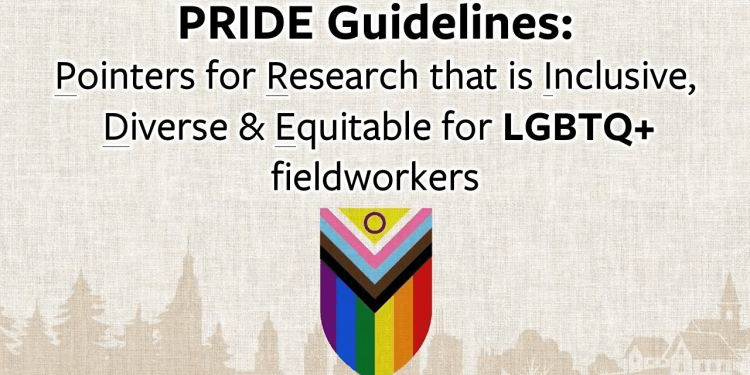
We wandered, naturally, into conversations about community, queerness, and what it means to make fieldwork safer and more inclusive for LGBTQ+ researchers. Just as with their science, Robin approaches this work with empathy, thoughtfulness and a refusal to let anyone feel alone where they should feel welcome.
If you think about it, that is ecology too. An ecosystem isn’t a collection of individuals. It’s a network of mutual shaping, mutual reliance, mutual influence. And Robin understands that academic communities — like forests — need to be tended. Not controlled, not manicured, but cared for, with an eye on who thrives, who struggles, and who has to bend themselves into silence or camouflage simply to belong.
They and their colleagues at Leeds have been building a set of resources designed to help field leaders support LGBTQ+ students and researchers.
A Debate, a Laugh, and a Reminder That Nothing Is Really Either/Or
It seemed inevitable that putting two quirky and queer environmental science communicators in the same place would lead to a bit of friendly chaos, so we indulged in a deliberately impossible debate: If you could only conserve one — tropical forests or boreal forests — which would you choose? (This is the first outing of a new Coffee & Geography Podcast feature called Grounds for Debate?)
Robin argued for the tropics; while I played devil’s advocate and argued for the boreal. We both convinced each other and also didn’t, and eventually we laughed ourselves into the obvious conclusion: the real world is never binary. Not in ecology. Not in climate. Not in life – something we both certainly feel in every fibre of our being, without a doubt! And perhaps that was the perfect metaphor for the entire conversation: complex, interconnected, not reducible to yes/no answers.
In the End, It Felt Like Finding a Fellow Traveller
When I think back on this episode, what I remember most isn’t the science or the anecdotes (though the tree‑hugging code will forever live rent‑free in my mind). It’s the sense of recognition. That quiet feeling you get when speaking with someone whose brain moves at a similar angle to yours — someone who sees the world as alive with geography, story, identity and possibility.
Robin reminded me that ecology is not just about forests. That geography is not just about landscapes. It is about belonging. That science, at its best, is an act of connection — between species, between communities, between the stories we inherit and the futures we imagine. And that, to me, is what makes these conversations so precious.

 Geogramblings