
Coffee & Geography Podcast Season 6 Episode 10
I’ve wanted to get Dr Anjana Khatwa onto the podcast for a long time. We’ve crossed paths a few times before, usually in busy conference settings where you get ten rushed minutes over machine coffee and then both disappear in opposite directions. So having the chance to sit down properly and talk – with actual time to range across geology, migration, belonging, access to nature, books, and even Agatha Christie, was a real treat!
One of the reasons I wanted Anjana on is that she makes geology feel human without dumbing it down. A lot of people can explain rocks. Far fewer can explain why they matter emotionally, culturally, historically, politically, and why we should care beyond “that looks interesting.” That combination sits right at the heart of her book, The Whispers of Rock, which has quite rightly picked up serious recognition. It was named a book of the year by Waterstones and New Scientist, and when you hear Anjana talk about her work, that acknowledgement makes complete sense.
We started with identity, because with Anjana that story is inseparable from geography. She talked through her family’s route from Rajasthan to Nairobi under British colonial rule, then through Partition and refugee camps in India, and eventually on to Slough, where she was born. It’s a lot to hold in one family story: migration, coercion, upheaval, colonial systems, rebuilding, and community. What I found especially striking was the way she linked all of that to place. Slough wasn’t just “where she was born”; it was part of a wider story of migrant community, labour, resilience and belonging. She was very clear that geography had shaped her identity long before she ever became a geologist.
And then there’s the basalt. The childhood photograph from Kenya – the one she often shares – really is one of those moments that explains a lot. She described being there, standing in front of the sign at the Shaitani lava flows in a very memorable field trip outfit, and then picking up a piece of vesicular basalt. That rock is still with her. It’s banged about now after years of being taken to talks and events, but it remains the thing she traces back to when she talks about “Jurassic Girl” and the start of her relationship with geology.
The main thing I took from the conversation, though, was Anjana’s insistence that rocks are missing from how many people talk about nature. She’s right. We celebrate trees, rivers, birds, flowers, fungi – and rightly so – but the geological foundation is often absent from public environmental storytelling. At one point she mentioned seeing a post celebrating nature without any mention of rocks or soils, and it clearly irritated her, because she sees this omission as a genuine misunderstanding of how life works. Her point was blunt and important: “The rocks are the fundamental basis of life on earth.”
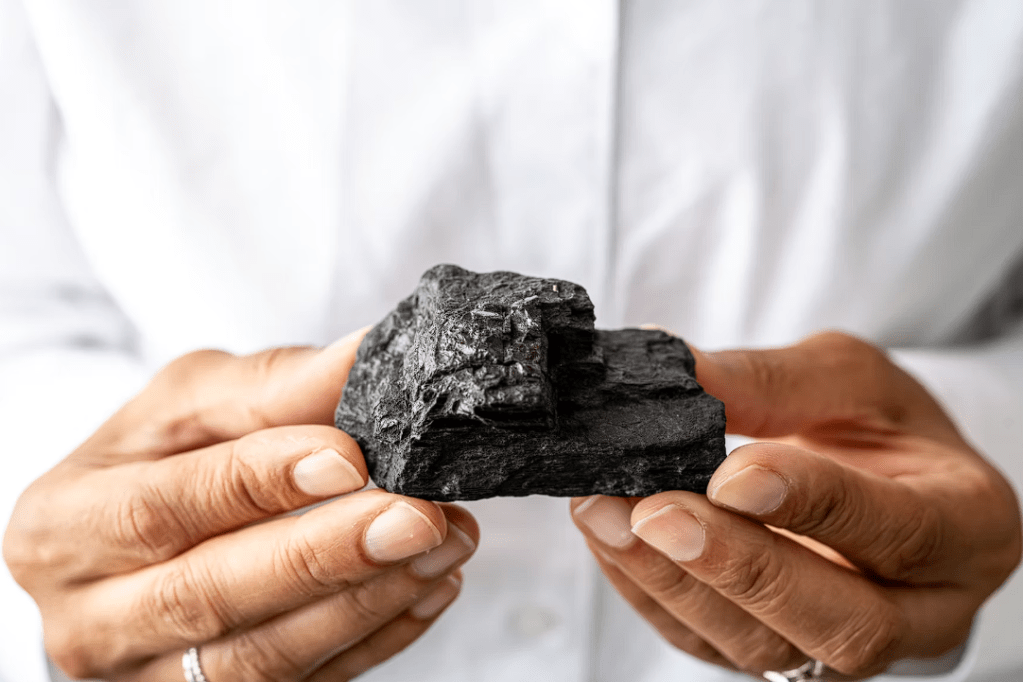
She talked me through one of the strongest passages in the book: the chapter on coal. This is where her storytelling is at its most effective. Coal’s ‘story’ is a tragic one, because of our use and changing relationship to it. Once loved for warmth and power, it is now seen as one of the villains of the climate crisis. We shouldn’t romanticise coal, but Anjana’s powerful argument is that blaming the rock itself misses the point. The problem is human extraction, consumption, and the inability to live within limits. That shift from “rock as enemy” to “human system as problem” is where her writing really does something different, and spoke to me quite strongly as an educator active in social justice issues and decolonisation.
There was also a really useful conversation about access to nature, and this is where Anjana’s current role at the National Trust came into the frame. She pushed back hard against the idea that global majority communities somehow “lack a connection” to nature. As she put it, the issue is not connection but accessibility. Access to transport, confidence in rural spaces, familiarity with the codes of those spaces, what to wear, how to navigate them, and how welcome you expect yourself to be. She’s clear that for many communities, faith and spirituality already provide very strong ways of relating to nature but that is not the same as having equitable access to Britain’s rural and coastal spaces.
I appreciated how practical she was about this. She wasn’t interested in surface-level “awareness raising” as an end in itself. Her point was that behind-the-scenes institutional work matters more in the long run: changing organisational culture, improving competence and confidence, and opening spaces up in ways that eventually mean someone like the Palestinian Explorer’s daughter can walk the coast and feel she belongs there as much as anyone else. It was a reminder that social media can make issues visible, but it doesn’t do the slow, often thankless structural work by itself.
And because this is still Coffee & Geography, and because not everything has to be earnest all the time, we also had a very fun detour into Agatha Christie. Anjana is a serious murder mystery fan. That led to a short Christie quiz, which I can confirm was much harder than I expected, and to some very strong opinions about Miss Marple, Poirot, and the delights of a good jigsaw puzzle. It was a nice reminder that people who do serious, thoughtful public work are still just people with hobbies and obsessions and favourite mugs.
By the end of the conversation, what I felt most strongly was that Anjana is doing more than talking about rocks. She is trying to change how we see the world under our feet and who gets to feel at home in the landscapes around them. That’s why the conversation worked so well for me. It went beyond the discipline of geology and into what happens when geology is allowed to meet story, migration, inequity, memory, cultural history, and public voice.
Rocks, truly, are powerful whisperers.
🔗 Anjana Khatwa – The Whispers of Rock / author website: https://www.anjanakhatwa.com/writing
🔗 Jurassic Coast World Heritage Site: https://www.jurassiccoast.org/what-is-the-jurassic-coast/
🔗 The Geological Society of London – R H Worth Award: https://www.geolsoc.org.uk/about-us/society-awards/r-h-worth-award/
🔗 National Trust – commitment to inclusion and diversity: https://www.nationaltrust.org.uk/who-we-are/about-us/our-commitment-to-inclusion-and-diversity
#CoffeeGeogPod #Geology #EarthScience #ScienceCommunication #JurassicCoast #WhispersOfRock #NatureWriting #InclusionInNature #NationalTrust #RockStories #GeographyEducation #PublicEngagement #DeepTime #ClimateCommunication #JurrasicCoast #AnjanaKhatwa

 Geogramblings