
I am delighted to publish this press release regarding the annual Gender Census. It is a fantastic initiative that demonstrates the beautful intersectionality between human geography and queerness.
By Cassian Lodge, GenderCensus.com
How do you refer to someone whose gender isn’t male or female? The Gender Census is an annual online survey that collects data on the language preferences of people whose genders (or lack thereof) are not fully explained, described or encompassed by the “gender binary” of male or female. Anyone who feels they fit this criterion is invited to participate. It asks about gender identity terms, titles and pronouns.
The survey typically receives tens of thousands of responses from all over the world, though it only collects data on the terms participants prefer when communicating in English. The first survey took place in 2013. In 2024 the survey received over 48,000 responses internationally, including over 5,000 from the United Kingdom. With statistics going back over a decade, this survey provides a wealth of accessible longitudinal data that has been used in business, academic research and activism.
The survey is voluntarily designed and published by citizen researcher Cassian Lodge (they/them) of Powys, Wales, and funded by crowdfunding. Cassian writes a summary report for anyone to use. Their goal is to enable everyone to refer to gender-divergent people in respectful and inclusive ways.
It opened on Wednesday 30th July 2025, and closes no sooner than 30th August 2025. Anyone wishing to be kept up-to-date can follow the project in various ways, including social media and a mailing list: gendercensus.com/follow/ To participate, go to survey.gendercensus.com.
Last year’s trends:
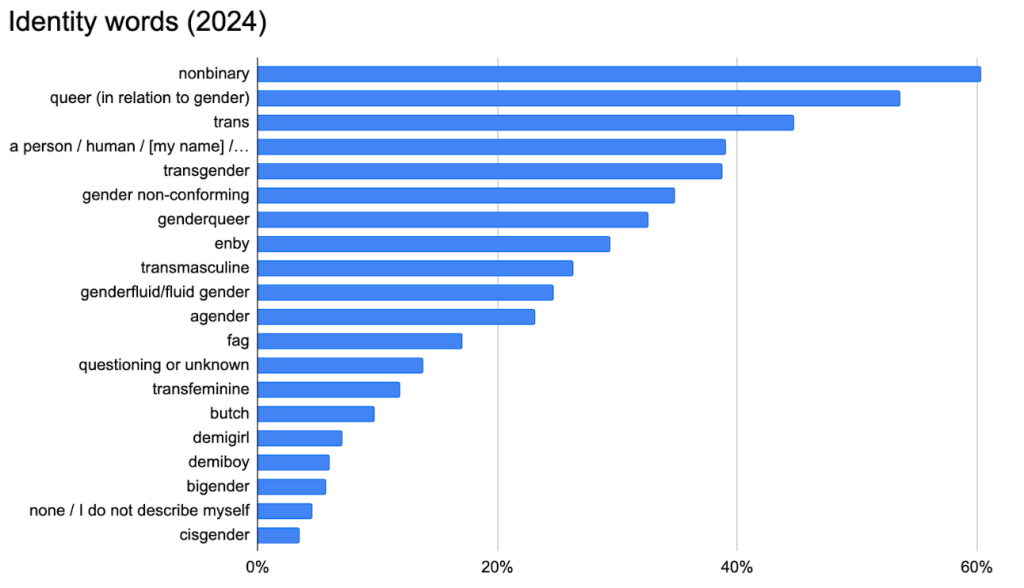
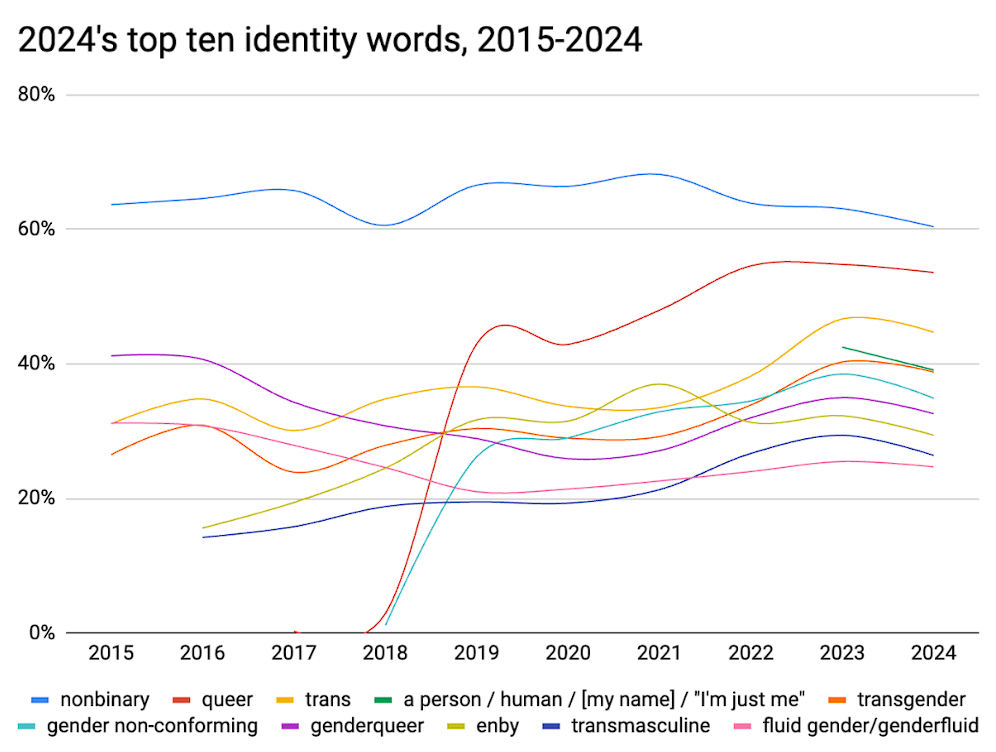
- Gender identity terms – popular in 2024 were nonbinary (60%), queer (54%), and trans (45%).
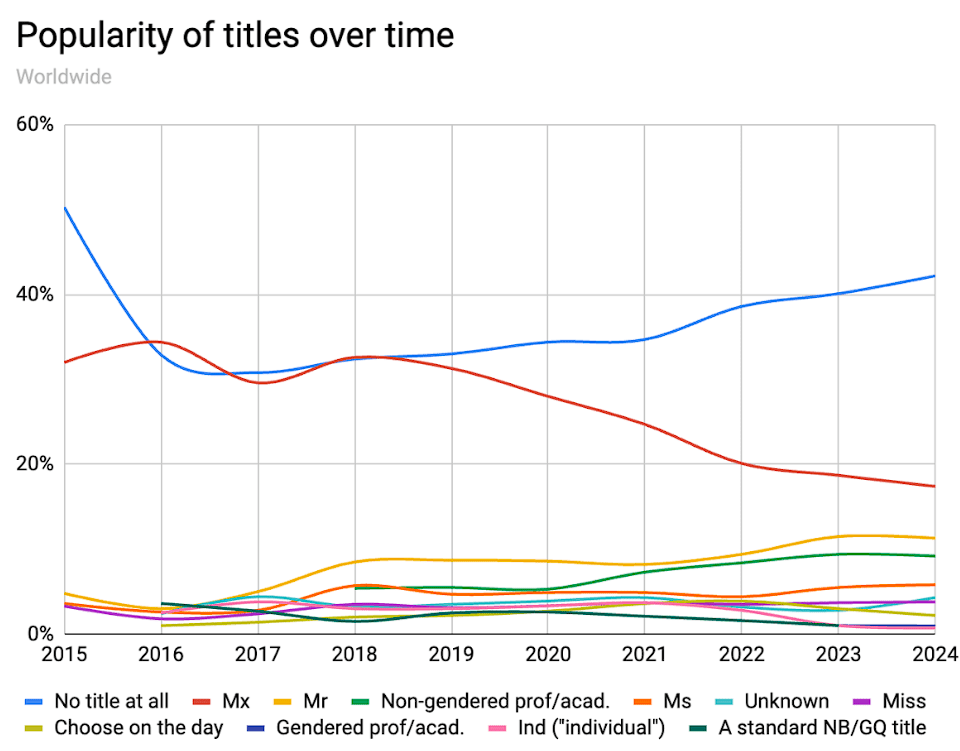
- Titles – popular in 2024 were no title at all (42%), Mx (17%) and Mr (11%).
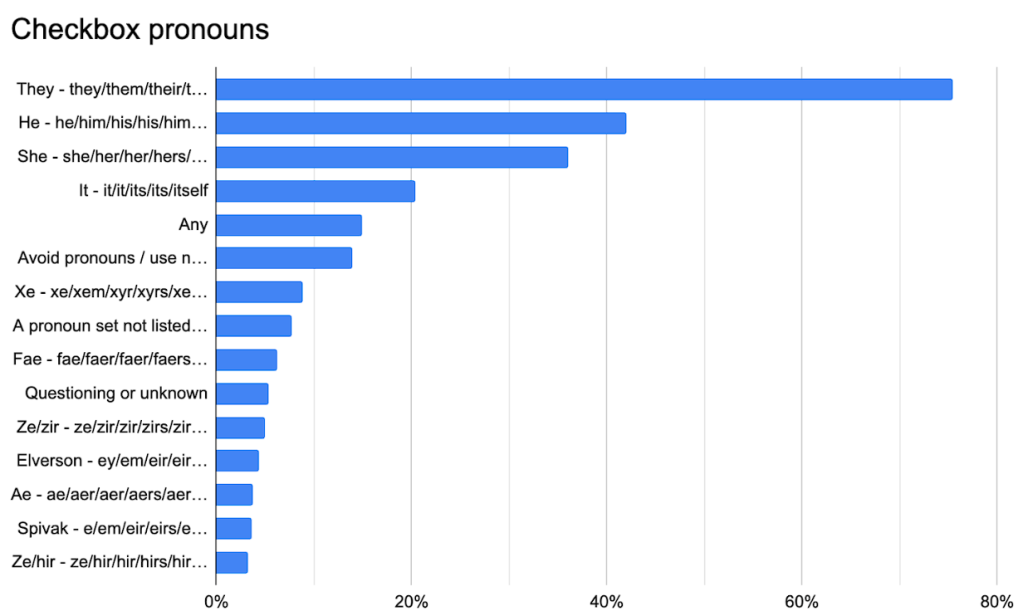
- Pronouns – popular in 2024 were they/them (75%), he/him (42%) and she/her (36%).
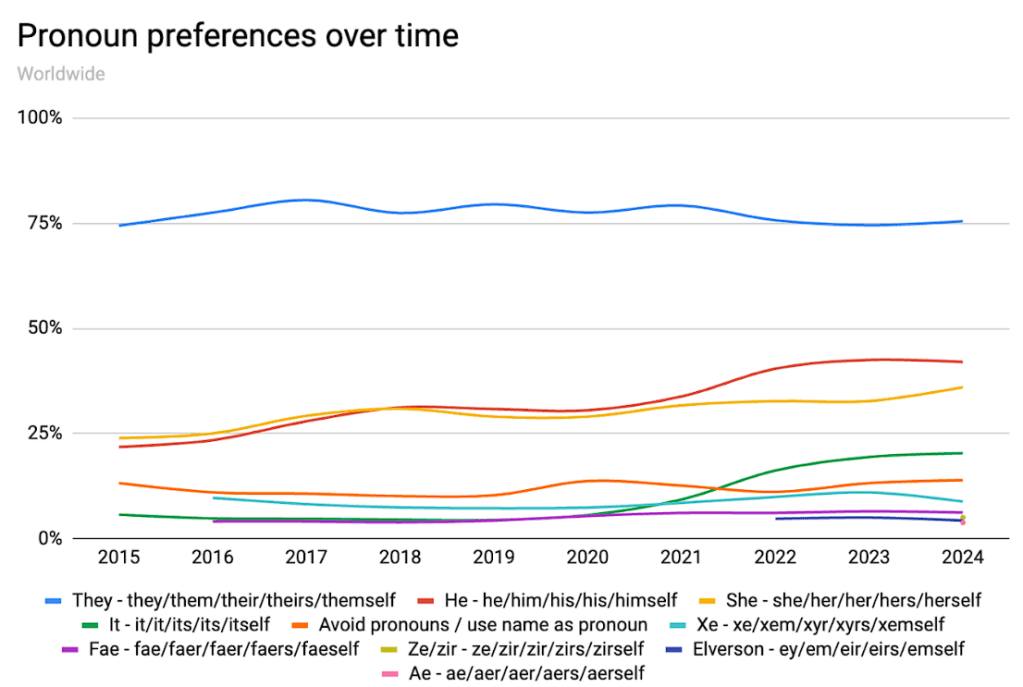
- Further reading: https://www.gendercensus.com/results/2024-worldwide
Quotes
“As an editor, I’m grateful for how the Gender Census has tracked the use of gender-related terminology over the years within the nonbinary community. I have been able to point to Gender Census data when helping writers make spelling and syntax choices.”
Kenna May (32yo professional, nonbinary and genderfluid, they/he/she pronouns, USA)
“I find the results very useful, both personally and professionally, specially the use of different pronouns through time. I tend to focus on trans issues on my linguistics research and having access to updated, relevant data is always the hardest part.”
Helio Miramontes (38yo academic, agender, they/them pronouns, Spain)
“The Gender Census has had a huge impact on my life. I take the results for my area of the world and write a report that I’ve been told has been used by teams working with queer youth to gain an idea of the language they use. It’s making sure we are seen.”
Apollo (24yo activist, TransNonbinary and Genderqueer, they/them pronouns, Australia)
“It’s great knowing that I’m helping get all ages represented in the Gender Census – there’s this myth that all non-binary people are young and having data like this helps push back against it. I make sure to participate every year with great joy!”
Ricky (50, agender, they/them pronouns, Australia)
“Through the Gender Census I was able to learn about people who feel the way I do, and about labels that describe my experience. I think it’s important as it offers a sense of community and belonging and the feeling of being seen. Someone cares to learn more. We do matter.”
Raquel (28, demigirl, he/him and she/her pronouns, Brazil)
“I enjoy taking the Gender Census and seeing the results from it each year. I feel like a part of our global community, and I love reading through the graphs/analyses and seeing changes over time. Studying and recording this is valuable work.”
Dill (nonbinary queer trans, they/them pronouns, UK)
“The gender census is like a holiday for me, I love getting the email that it’s open and the email for the results. I’m just a big fan of surveys and data!”
Marlene (18, femme lesbian, Any pronouns, USA)
“I’ve been following the data from the Gender Census since the survey began and it has truly enriched my life and the lives of those I’ve shared it with. Understanding that I’m not alone in the world has made a huge difference.”
Revel (51, trans, nonbinary and genderqueer, they/them pronouns, USA)
Useful sources for illustration:
- The Gender Spectrum Collection: https://genderspectrum.vice.com (Free to use)
- LGBTQ+ on Pexels: https://www.pexels.com/search/LGBTQ+/
- Generic stock photo and graphs showing long-term trends are provided: https://drive.google.com/drive/u/0/folders/12njM3z50s7URSGUxTY19lpunTVqBwMkc
Terminology notes:
- Avoid naming specific genders, as they can bias results. (E.g. If it is promoted as a “nonbinary survey”, people who describe themselves as nonbinary are more likely to participate, and people who don’t are more likely to ignore it, leading to nonbinary people being overrepresented in results.) The target demographic is: people whose genders don’t fit the restrictive binary of “always, solely and completely male or always, solely and completely female”. The “or” is important; the gender binary dictates that everyone must be one or the other but never both.
- Diverse vs. divergent: As a group, potential participants should be described as gender-divergent, not gender-diverse. This is because humans as a species are diverse, but the survey is targeting the subset who diverge from the “norm”.

 Geogramblings