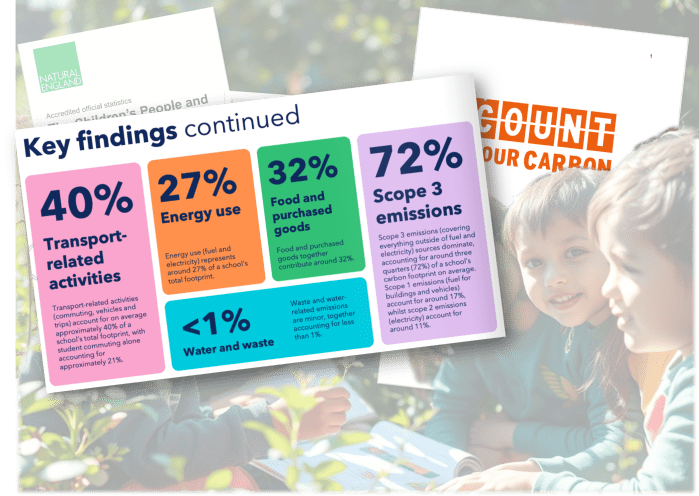
Infographic showing key findings on environmental impact: 40% transport, 27% energy, 32% food, 72% scope 3 emissions, under 1% water/waste, over a blurred image of children outdoors.

Schools are not neutral: What school carbon data reveals about responsibility, modelling, and care

Part 3 of the "This Isn't Activism: It's a Duty of Care" series discusses the findings of the Count Your Carbon 2026 report, which analyses carbon emissions from over 1,600 schools in England. It reveals that structural decisions, such as transportation and food sourcing, significantly contribute to school emissions, often beyond childrenโ€™s control. I emphasise that framing climate responsibility on students is misleading and may lead to emotional burdens, and so there is a need for institutional honesty and alignment of actions with the realities of carbon impact to support safeguarding rather than shifting blame onto young people.

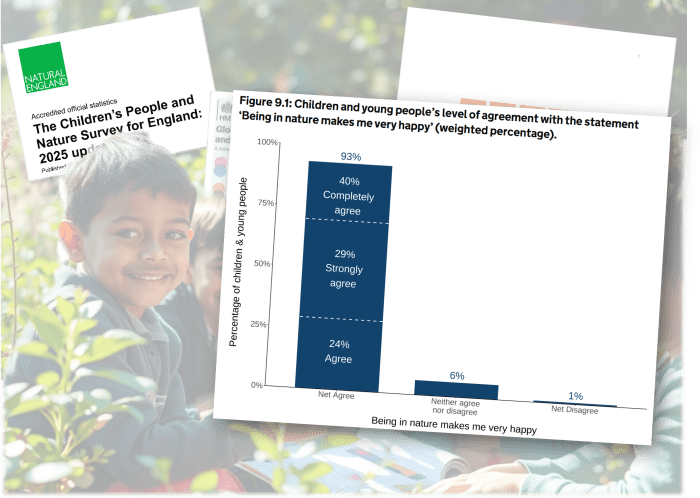
A bar chart shows that most children and young people in England agree that being in nature makes them happy, with 40% completely agreeing and 29% strongly agreeing.

Children already know this matters: What Natural England’s Survey tells us about wellbeing, inequality, and care

Part 2 of the "This Isn't Activism: It's a Duty of Care" series on climate education. I look at the importance of understanding children's experiences and relationships with nature as revealed in the Childrenโ€™s People and Nature Survey for England, highlighting that most children feel happy in nature, but access to it is uneven, influenced by factors like income and ethnicity. Safeguarding frameworks need to account for these inequalities, as childrenโ€™s emotional connections to nature exist before climate-related concerns. Educators should approach these topics with care, awareness, and honesty rather than avoidance or panic.

Curriculum Reform, Climate Literacy & Safeguarding: Decolonising What We Teach (and Why) in Light of the DfE Review

The Department for Education's Curriculum and Assessment Review outlines potential educational reforms by 2028. While improvements are noted, significant gaps remain in curriculum time and assessment for climate education. Action steps for school leaders to mitigate shortfalls include embedding climate education into policies, assessing decolonial practices, and enhancing teacher training. A free subscription is required to read this post.

Drake Primary School’s Climate Journey: A Success Story

Drake Primary shows how climate action and safeguarding can work hand-in-hand. From energy audits to outdoor learning and eco-anxiety support, their journey proves sustainability isnโ€™t an add-onโ€”itโ€™s a mindset. Hereโ€™s what schools can learn from their whole-school approach.

Londoner Annie Risner Supporting Education Settings in the Charge for Climate Action

The Climate Ambassadors scheme empowers young people to address climate change, with nine regional hubs across England. Annie Risner, leading the London hub, draws from her diverse background and community engagement experience. Her focus is on empowering schools and early years settings, fostering collaboration, and promoting creative climate action. With her leadership and the scheme's support, London's youth are empowered to create a more sustainable future.

Calling All Climate Champions: Meet Cormac, Northwest Climate Ambassador Regional Manager

In a recent episode of the Coffee & Geography Podcast, I sat down with Cormac Lawler, the dynamic new Regional Hub Manager for the Climate Ambassadors scheme in the Northwest of England. A self-proclaimed "sociable introvert" with a passion for community and the environment, Cormac is the perfect person to lead this important initiative. Originally … Continue reading Calling All Climate Champions: Meet Cormac, Northwest Climate Ambassador Regional Manager