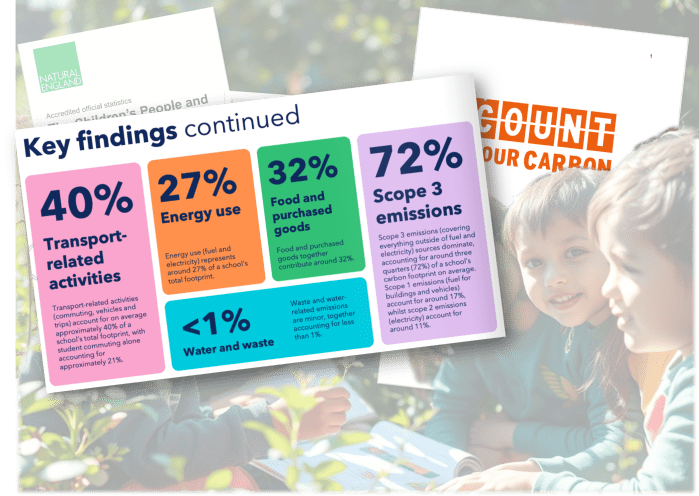
Infographic showing key findings on environmental impact: 40% transport, 27% energy, 32% food, 72% scope 3 emissions, under 1% water/waste, over a blurred image of children outdoors.

Schools are not neutral: What school carbon data reveals about responsibility, modelling, and care

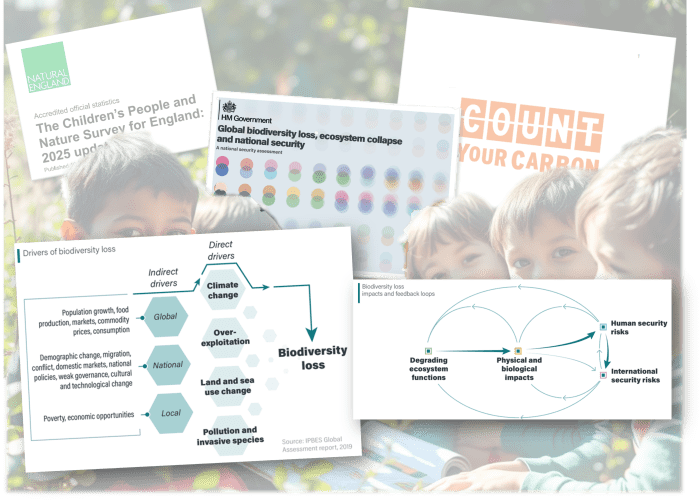
Part 3 of the "This Isn't Activism: It's a Duty of Care" series discusses the findings of the Count Your Carbon 2026 report, which analyses carbon emissions from over 1,600 schools in England. It reveals that structural decisions, such as transportation and food sourcing, significantly contribute to school emissions, often beyond childrenโ€™s control. I emphasise that framing climate responsibility on students is misleading and may lead to emotional burdens, and so there is a need for institutional honesty and alignment of actions with the realities of carbon impact to support safeguarding rather than shifting blame onto young people.

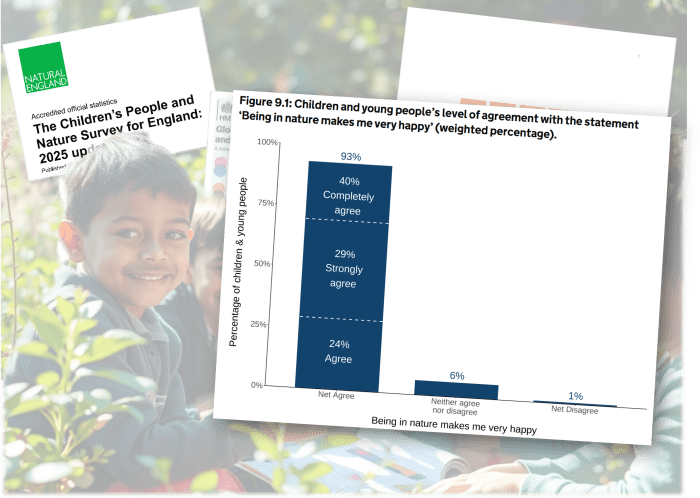
A bar chart shows that most children and young people in England agree that being in nature makes them happy, with 40% completely agreeing and 29% strongly agreeing.

Children already know this matters: What Natural England’s Survey tells us about wellbeing, inequality, and care

Part 2 of the "This Isn't Activism: It's a Duty of Care" series on climate education. I look at the importance of understanding children's experiences and relationships with nature as revealed in the Childrenโ€™s People and Nature Survey for England, highlighting that most children feel happy in nature, but access to it is uneven, influenced by factors like income and ethnicity. Safeguarding frameworks need to account for these inequalities, as childrenโ€™s emotional connections to nature exist before climate-related concerns. Educators should approach these topics with care, awareness, and honesty rather than avoidance or panic.

Curriculum Reform, Climate Literacy & Safeguarding: Decolonising What We Teach (and Why) in Light of the DfE Review

The Department for Education's Curriculum and Assessment Review outlines potential educational reforms by 2028. While improvements are noted, significant gaps remain in curriculum time and assessment for climate education. Action steps for school leaders to mitigate shortfalls include embedding climate education into policies, assessing decolonial practices, and enhancing teacher training. A free subscription is required to read this post.

EVENT NEWS: How to talk to children about the climate crisis (20 Sept 2023 19:00, Norwich Theatre Stage Two)

I am delighted to have been invited by Norwich Theatre to contribute to their Creative Matters: Climate Stories programme. My story, titled 'How to talk to children about the climate crisis' will be take place on Wednesday 20th September at 19:00, and will be a session combining performance poetry, prose and an informative talk.

The DfE Draft Strategy on Climate Change & Sustainability Education: A Headโ€™s Up & A Head Start

Many say that COP26 ended last November with not much to cheer about. But it did give us educators plenty food for thought. Secretary of State for Education Nadhim Zahawi gave encouraging sentiments regarding the Department for Educationโ€™s (DfE) plans to improve climate change and sustainability education in England. A draft strategy has been published and here I will offer a brief overview with some light analysis and what schools can do to get a head-start.

Original art produced for 'The Phoenix' by Laila Arรชde.

Teachers: we have climate-anxious youngsters, but can we do something about it

An excerpt from an article that I wrote for 'The Phoenix', a newletter by climate journalist Eric Holthaus, which focusses "most closely on humanizing this planetary emergency: being transparent about the challenges weโ€™re facing and the complex emotions weโ€™re all feeling, and being honest about what we need to do to radically transform our society." The banner image is original art produced for 'The Phoenix' by Laila Arรชde.

School safeguarding policy should consider climate change and eco-anxiety

A combination of research and experience has led me to strongly believe that climate change should be considered a safeguarding issue, therefore senior leadership at any school should give it greater attention. If you are a teacher in need of a compelling argument to take to your SLT, this could be it.

Available Now: GeogPod Podcast Interview

Live Now: My GeogPod Interview where I talk to John Lyon about why climate change is a safeguarding issue, eco-anxiety, how to navigate the politics of climate change, and teaching students to think critically about the climate.

Climate Change: A Safeguarding Issue?

This week, the Autumn 2020 edition of the Geographical Association's GA magazine was published. Published in the it is an article I authored titled "Climate Change - A Safeguarding Issue?". I feel now is the right time to put forward the argument that climate change issues should be considered when it comes to a school's safeguarding duties.